


The analysis of water exchange in Visovac Lake and the influence of the lake system on the transformation of runoff
The Krka River is characterized by a marked change in its course between river and lakes, which is a consequence of the growth of tufa barriers
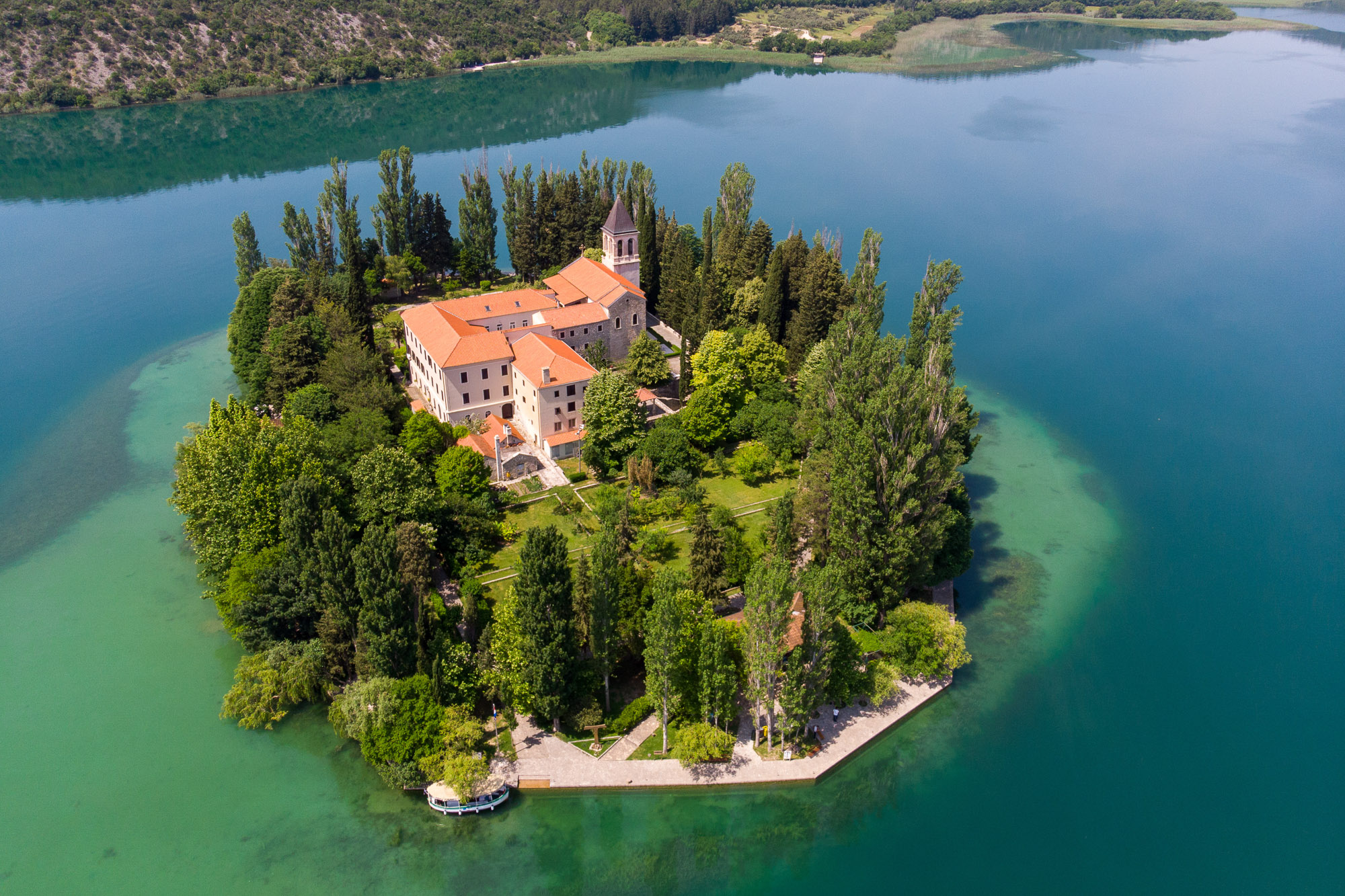
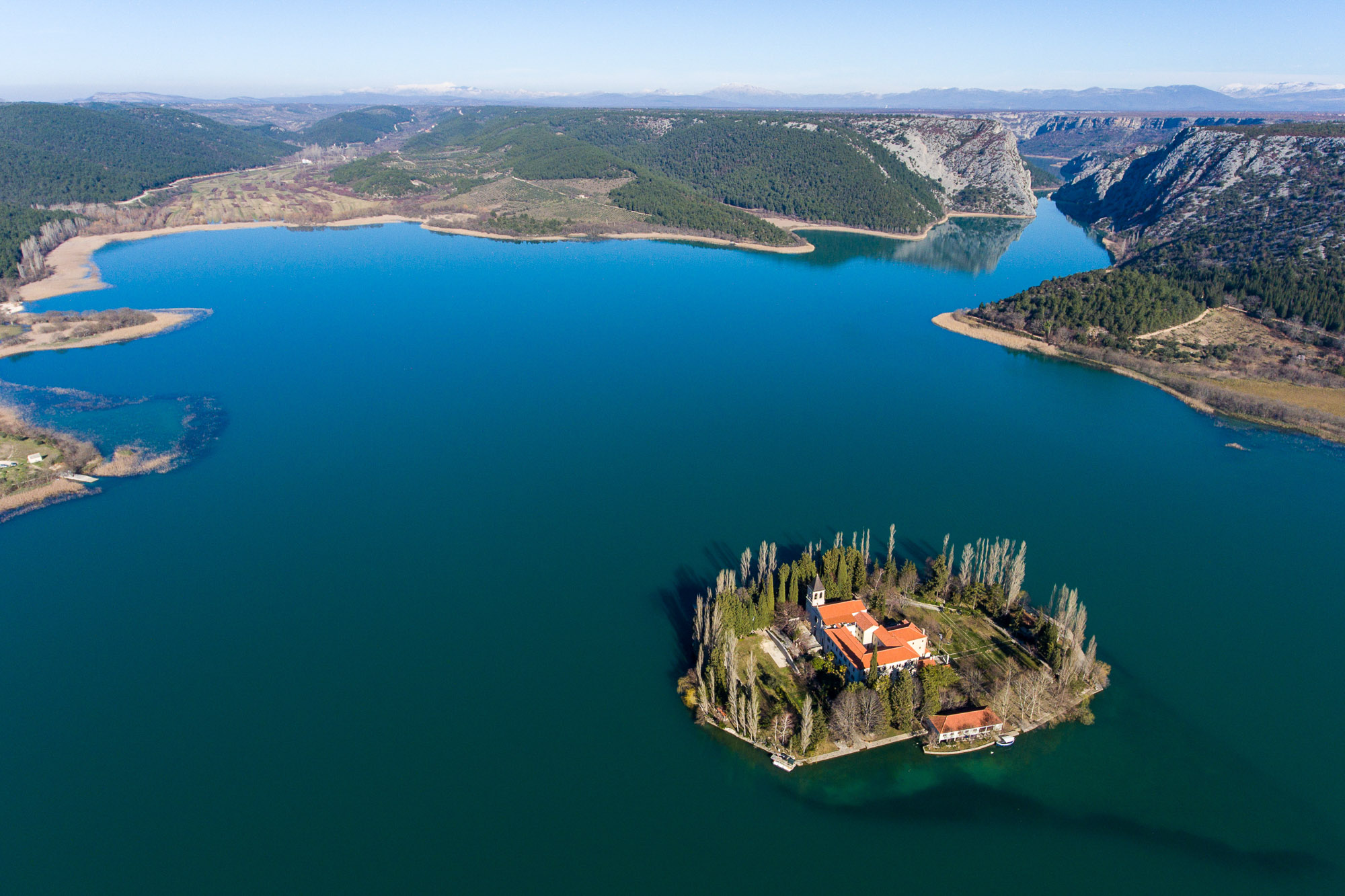
The most significant freshwater lake system on the Krka is Visovac Lake, which is a typical canyon lake and also a crypto-depression. In terms of depth, it belongs among deep lakes (deeper than 15 m), and in terms of surface area to medium lakes (with a surface area ranging from 1 to 10 km²).
Given the impact of the exchange of water in Visovac Lake on the lake ecosystem, the hydrological component of these exchanges was considered in the context of this project. The component of water flow through the lake is very pronounced: it is calculated that the theoretical time of water exchange in it is 28 days, that is, that it is changed on an average of thirteen times a year. However, during drier years, such as 1989, the theoretical water exchange time is extended by more than twice (to 64.5 days), which means that it is exchanged an average of 5.7 times per year. On the other hand, during the occurrence of large water waves on the Krka River, the water exchange process in Visovac Lake becomes more dynamic, so that, for example, the calculated exchange time in May 2023 was much shorter – it measured only 12.6 days.
Forecasts of the impact of climate change on the dynamics of water exchange in the lake have also been made. As predicted by the climatic and hydrological models used, it was established that if the mean annual flows decreased by 10%, the water exchange time would increase to 31.4 days, while if they decreased by 20%, it would increase to 35.4 days, and if they decreased by 30%, it would increase to 40.4 days. In such cases, it would be possible to increase the water exchange to almost double the recent values.
The actual water exchange time depends to a great extent not only on the morphology of the riverbed and the hydrological balance of water outflow from it, but also on the lake thermals and the hydrodynamics of the water flow, which is associated with the periodic stratification of lake masses. In seasonal conditions of more pronounced vertical thermal differentiation of water masses, longitudinal water movement occurs predominantly through the epilimnion, which complicates and slows down the exchange of water throughout the entire lake system. Precisely because of the relatively short water exchange time and the pronounced flow of water through it, the epilimnion layer is relatively shallow (2-5 m), and the thermocline layer below it is very extended, which dynamizes the water exchange in the lake. Based on the monitoring conducted, it was confirmed that Visovac Lake belongs to warm monomictic lakes with complete mixing of the entire water mass once a year. In the winter, an isothermal process occurs – the water on the surface of the lake cools to the temperature of the water in the lower layers, so under these conditions, the water in the lake is regularly mixed from the surface downwards, thus refreshing it. This is a very dynamic system with a relatively short theoretical water exchange time, which has a positive impact on changes to a number of other abiotic and biotic factors in this extremely valuable protected water resource.
Research
JOŠ NOVOSTI IZ KATEGORIJE
Assessing the status of the Middle Spotted Woodpecker and the European Nightjar in the broader area of the Krka NP
During 2026, the Zidarčac environmental firm conducted investigations into the Middle Spotted Woodpecker (Leiopicus medius) and the European Nightjar (Caprimulgus europaeus) in the broader area of the Krka National Park
The investigation and inventorizing of the entomofauna of forest habitats in the region of the Krka National Park
During 2025 and 2026, the Faculty of Forestry and Wood Technology of the University of Zagreb conducted entomofaunistic research in the most important forest communities in the Krka National Park to gain insight into the representation and condition of the insect fauna in the Park
A topographical map was created of potential speleological sites in the broader area of the Krka National Park
The underground world of karst is one of the most valuable components of the natural heritage of the Krka National Park, but also the most difficult to access
Investigation of the condition and composition of the macrozoobentos of the tufa barriers of the Krka River
During 2024 and 2025, an extensive scientific study of the composition and condition of macrozoobenthos (benthic invertebrates) was conducted on all seven tufa barriers of the Krka River